In short
Chess is played by two players, White and Black, on a board of 64 squares. White moves first, and the players take turns moving one piece each. Pieces capture by moving onto an enemy piece's square. The aim is checkmate: attacking the opponent's king so that it has no way to escape. A game can also end by resignation, by running out of time, or in a draw, such as by stalemate or agreement.
Chess has a reputation for being complicated, but the rules fit on a page. The depth comes from how the pieces work together, not from the number of rules. This guide covers everything you need for your first game: the board, how each piece moves, check and checkmate, the three special moves, how a game is won or drawn, and the clock. Each section links to a fuller guide when you want the details.
1What is the aim of chess?
The aim is to checkmate your opponent's king. The FIDE Laws of Chess put it simply: each player tries to place the opponent's king under attack in such a way that the opponent has no legal move that gets out of it. You never actually capture the king. The game ends as soon as the king is checkmated.
Capturing pieces is a means, not the goal. A player with fewer pieces who checkmates first still wins. That said, having more pieces than your opponent makes checkmate much easier to achieve, which is why winning material is such a big part of practical play.
2How is the board set up?
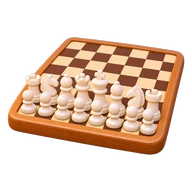
The board is turned so each player has a light square in the right-hand corner nearest them. The rooks go in the corners, then the knights, then the bishops. The queen goes on the square of her own colour in the middle (the white queen on d1, the black queen on d8) and the king next to her on the e-file. The pawns fill the row in front.
 8


 7
 2
 1a
 b
 c
 d
 efgh
3Who moves first in chess?
White always moves first, and then the players take turns, one move each. You cannot pass: on your turn you must make a move. Each move moves one piece, with one exception, castling, which moves the king and a rook together. In a tournament the pairings decide who plays White; in a casual game you can draw lots, for example by hiding a pawn of each colour in your hands.
4How do the chess pieces move?
| Piece | How it moves | Each side starts with |
|---|---|---|
| King | One square in any direction | 1 |
| Queen | Any number of squares in a straight line: along a rank, a file or a diagonal | 1 |
| Rook | Any number of squares along a rank or a file | 2 |
| Bishop | Any number of squares diagonally | 2 |
| Knight | In an L: two squares one way and one square at a right angle. It jumps over pieces | 2 |
| Pawn | One square straight forward, or two from its starting square. It captures one square diagonally forward | 8 |
A piece captures by moving onto a square occupied by an enemy piece, which is removed from the board. Every piece captures the way it moves, except the pawn, which moves straight but captures diagonally. You can never capture your own pieces, and no piece except the knight can pass through an occupied square. The full guide to how the pieces move has a board for each one.
5What is check in chess?
Your king is in check when an enemy piece attacks it: that piece could capture the king on its next move if the king stayed where it is. You must get out of check at once. There are three ways, and any legal one will do.
- 1Move the king to a square that is not attacked.
- 2Capture the piece giving check.
- 3Block the check by putting a piece between the king and the attacker. This does not work against a knight, which jumps, or against a piece on the next square.
8721abcdeghYou are never allowed to make a move that leaves your own king in check, or that puts it into check. That also means a piece that is shielding your king from an attack cannot move off the line if doing so would expose the king. Such a piece is pinned. You do not have to say "check" when you give one; the rules do not require it, though many casual players do.
6What is checkmate?
Checkmate is a check with no way out: the king is attacked, and no move of the king, no capture and no block removes the attack. The player who is checkmated loses, and the game ends at once.
8721abcdefgh8721abcegh7What are the special moves in chess?
Three moves follow rules of their own. You will see all three in your first few weeks of play, so it is worth knowing them from the start.
- Castling: once per game, the king moves two squares towards a rook, and the rook jumps to the square on the king's other side. It is allowed only if neither piece has moved, the squares between them are empty, the king is not in check, and the king does not pass through or land on an attacked square.
- En passant: if a pawn moves two squares from its starting square and lands beside an enemy pawn, that enemy pawn may capture it as if it had moved only one square, but only on the very next move.
- Promotion: a pawn that reaches the far end of the board is replaced, as part of the same move, by a queen, rook, bishop or knight of the same colour. You choose, and you may have more than one queen.
8How do you win at chess?
There are three ways to win a game. Checkmate is the main one. Your opponent can also resign: a player who sees the game is lost may stop and concede, which counts as a win for the other side. And in a game with a clock, you win if your opponent runs out of time, as long as you still have a way to checkmate them by some series of legal moves.
Resigning is normal and polite once a position is hopeless, for example when your opponent is a queen ahead with no way back for you. Beginners are often told never to resign, and in your first games playing on is a good way to learn how checkmates work. Against an opponent of your own level, mistakes on both sides are common, so a position that looks lost can still turn round.
9How can a chess game end in a draw?
- Stalemate: the player to move is not in check but has no legal move. The game is drawn at once.
- Agreement: one player offers a draw and the other accepts. Some tournaments restrict early draw offers.
- Threefold repetition: the same position occurs for the third time with the same player to move and the same possible moves; a player may claim a draw. On the fifth occurrence the game is drawn automatically.
- The fifty-move rule: fifty moves by each player without a capture or a pawn move; a player may claim a draw. After seventy-five such moves it is drawn automatically.
- Dead position: neither player can checkmate by any series of legal moves, such as king against king, or king and bishop against king. The game is drawn at once.
- Timeout against insufficient material: a player runs out of time but the opponent could not checkmate them by any series of legal moves.
Stalemate is the draw that catches beginners most often. With a big material advantage, it is easy to take away the last free square of the enemy king without giving check. When your opponent has only a king left, check before every move that their king will still have a legal move or be in check.
10Do you play chess with a clock?
Not necessarily. Casual games at home are often played without one. Clubs, tournaments and online games use a chess clock, which gives each player a set amount of time for the game, sometimes with a few seconds added after every move. Fast games are called blitz or bullet; longer ones rapid or classical. When your time runs out, you lose, unless your opponent has no way to checkmate you, in which case it is a draw.
11Other rules worth knowing before your first game
- Touch move: in games played under the rules, if you deliberately touch one of your pieces on your turn, you must move it if it can move. Say "I adjust" first if you only want to straighten it.
- A move is finished when you let go of the piece. It cannot be taken back in a rated game.
- Use one hand to move, and in a game with a clock, press the clock with the same hand.
- An illegal move, such as one that leaves your king in check, must be corrected. In a tournament, the arbiter applies the penalties.
- Moves are recorded in algebraic notation, such as e4, Nf3 or O-O. Knowing it lets you write down your games and read books and guides.
12Common beginner mistakes about the rules
- "Stalemate is a win for the player with more pieces." No, it is a draw.
- "A pawn can only promote to a piece that has been captured." No. You may promote to any queen, rook, bishop or knight, even if you already have one.
- "You can castle out of check or after the king has moved and come back." No. The king must not have moved at all, and you cannot castle while in check.
- "Pawns capture straight ahead." No. A pawn moves straight but captures only diagonally forward.
- "The king can be captured." No. A position where the king would be captured is checkmate, and the game ends before that.
13What to do after you learn the rules
Play games. The rules make sense quickly once you see them on the board. Start against an opponent at your level, without a clock, and after each game look at the moments where you lost material or missed a capture. Learn two basic checkmates, king and queen against king and king and rook against king, so you can finish games you have won. Then learn a few opening principles: control the centre, develop your knights and bishops, and castle early.