In short
The king moves one square in any direction. The queen moves any number of squares in a straight line or along a diagonal. The rook moves any number of squares along a rank or file, and the bishop any number along a diagonal. The knight jumps in an L shape, two squares one way and one to the side, over anything in its path. A pawn moves straight forward one square, or two on its first move, and captures one square diagonally forward.
Chess has six kinds of piece, and each moves in its own way. Learn the six movements and you can play a legal game; everything else in chess, from tactics to endgames, is built on them. This guide takes the pieces one at a time, each on a board, then covers how they capture, the three special moves, how to set up the board and the mistakes beginners make most.
1What are the chess pieces called?
Each side starts with sixteen pieces: one king, one queen, two rooks, two bishops, two knights and eight pawns. One side has the light pieces and is called White; the other has the dark pieces and is called Black. White always moves first, and the players then take turns, one move each.
| Piece | How many | Letter in notation | Where it starts (White) |
|---|---|---|---|
| King | 1 | K | e1 |
| Queen | 1 | Q | d1 |
| Rook | 2 | R | a1 and h1 |
| Bishop | 2 | B | c1 and f1 |
| Knight | 2 | N | b1 and g1 |
| Pawn | 8 | none | the second rank, a2 to h2 |
In written moves, the letter names the piece and the square names where it went, so Nf3 means a knight moved to f3. Pawns have no letter: e4 means a pawn moved to e4. The knight is N because K is already the king. If the notation is new to you, read the guide to algebraic notation after this one.
2How do you set up a chessboard?
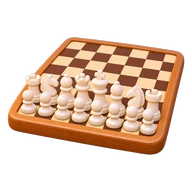
Turn the board so that each player has a light square in the bottom right corner. Put the rooks in the corners, the knights next to them, then the bishops. The queen goes on the remaining square of her own colour: the white queen on a light square, the black queen on a dark one. The king takes the last square beside her. Fill the second rank with white pawns and the seventh with black pawns.
 8


 7
 2
 1a
 b
 c
 d
 efgh
3How does the king move?
The king moves one square in any direction: forwards, backwards, sideways or diagonally. In the middle of an empty board that gives it eight squares. It is the most important piece, because the whole game is about it: when a king is attacked and cannot escape, the game is over.
There is one limit no other piece has: the king may never move to a square where it could be captured. An attack on the king is called check, and a player in check must get out of it at once, by moving the king, blocking the attack, or capturing the attacking piece. If none of those is possible, it is checkmate and the game ends. For the same reason the two kings can never stand on neighbouring squares, since each would be attacking the other.
4How does the queen move?
The queen moves any number of squares in a straight line, along a rank, a file or a diagonal, as long as nothing is in the way. She combines the moves of the rook and the bishop, which makes her the strongest piece on the board. She cannot jump: a piece in her path stops her, and if it is an enemy piece she can capture it.
Because she is so strong, beginners often bring the queen out early. That usually backfires: the opponent develops pieces while chasing her, and every tempo spent moving the queen again is a tempo not spent on the rest of your army.
5How does the rook move?
The rook moves any number of squares along a rank or a file, forwards, backwards or sideways, but never diagonally. Like the queen it stops at the first piece in its path, capturing it if it belongs to the opponent.
Rooks start in the corners, hidden behind the pawns, so they are usually the last pieces to join the game. They are at their best on open files, files with no pawns on them, and on the seventh rank, where they attack the opponent's pawns from the side. Two rooks working together on the same file or rank are a powerful pair.
6How does the bishop move?
The bishop moves any number of squares diagonally, in any of the four diagonal directions, until a piece blocks it. Because it only ever moves diagonally, a bishop stays on the colour it started on for the whole game. Each side has one light-squared bishop and one dark-squared bishop, and together they can reach every square.
A bishop is strongest in the centre and on open diagonals. One that is hemmed in by its own pawns standing on its colour has few squares and is called a bad bishop. That is worth remembering when you choose which pawns to push.
7How does the knight move in chess?
The knight moves in an L shape: two squares in a straight line, then one square to the side. Another way to see it: a knight always lands on a square of the opposite colour, at the nearest squares that are not on the same rank, file or diagonal. It is the only piece that can jump over others, so pieces in between do not block it. It captures only on the square it lands on, never the pieces it jumps over.
hA knight in the centre has eight squares; on the edge it has four or fewer, and in a corner only two. That is why players say a knight on the rim is dim. The jump also makes knight forks easy to miss: a knight can attack two pieces at once from a square neither of them can see. If the knight's shape still feels awkward, the knight routes drill trains it until it is automatic.
8How do pawns move in chess?
Pawns are the only pieces that never move backwards. A pawn moves one square straight forward, and on its very first move it may move two squares instead, if both squares are empty. It cannot move forward onto an occupied square, whoever's piece is there, so two pawns facing each other on the same file block each other.
Unlike every other piece, a pawn captures differently from how it moves: one square diagonally forward. A pawn on e4 can take a piece on d5 or f5, but not the piece on e5 directly in front of it.
8721abcdefghPawns are worth the least of the pieces, but they shape the whole game. They decide which squares are safe for your pieces, which files open for your rooks, and in the endgame a pawn that reaches the far side of the board becomes a queen.
9How do chess pieces capture?
A piece captures by moving onto a square occupied by an enemy piece, which is removed from the board. Every piece except the pawn captures exactly the way it moves: the rook along its lines, the bishop along its diagonals, the knight with its jump. Capturing is never compulsory in chess, so you may ignore a piece you could take. You can never capture your own pieces, and nobody ever captures the king: the game ends at checkmate, one move before that could happen.
10What are the special moves in chess?
Three moves break the ordinary patterns. Each has its own guide, but here is what they are.
- Castling: the king moves two squares towards one of its rooks, and that rook jumps to the square the king crossed. It is the only move in which two of your pieces move at once. You may castle only if neither the king nor that rook has moved, the squares between them are empty, and the king is not in check, does not pass through an attacked square and does not land on one.
- En passant: when a pawn advances two squares from its starting square and lands beside an enemy pawn, that enemy pawn may capture it as if it had moved only one square. The capture must be made on the very next move or the chance is gone.
- Promotion: a pawn that reaches the last rank is replaced, as part of the same move, by a queen, rook, bishop or knight of the same colour. Almost everyone chooses a queen, so you can have two queens or more.
11Chess pieces and their moves at a glance
| Piece | How it moves | How it captures | Can it jump? |
|---|---|---|---|
| King | One square in any direction | The same | No |
| Queen | Any distance along a rank, file or diagonal | The same | No |
| Rook | Any distance along a rank or file | The same | No |
| Bishop | Any distance along a diagonal | The same | No |
| Knight | Two squares one way, then one to the side | The same | Yes |
| Pawn | One square forward, or two from its starting square | One square diagonally forward | No |
12How do you win a game of chess?
You win by checkmate: the opponent's king is in check and no legal move gets it out. A game can also be won when the opponent resigns or runs out of time. If the player to move is not in check but has no legal move at all, that is stalemate, and the game is a draw, not a win. Draws also come from agreement, the same position repeated three times, fifty moves by each side without a capture or a pawn move, and positions where neither side has enough material left to mate.
13Common beginner mistakes with the pieces
- Setting up the board the wrong way round. Check for the light square in the bottom right before you start.
- Swapping the king and queen. The queen goes on her own colour, so the kings face each other on the e-file.
- Moving the knight in a straight line of three. It is two and then one to the side, and it always changes the colour of its square.
- Capturing straight ahead with a pawn. Pawns capture only diagonally forward, and they cannot take what is directly in front of them.
- Forgetting that the king cannot move into check, or leaving your own king in check. A move that does either is illegal.
- Thinking a bishop can switch colours. It cannot, so a light-squared bishop can never attack a piece on a dark square.
- Taking every piece you can. Capturing is optional. Before you take, check what the opponent can take back.
14How to practise the moves
Knowing how the pieces move and seeing their moves quickly are two different skills. Play short games against a computer opponent set to an easy level, and use board vision drills to train the coordinates and the knight's jumps. When a game is over, a review shows where a piece was left loose, which is the fastest way to learn what each piece can really reach.